
Meet Kioni's teammates
One human. Four agents. Built from Nairobi, in the order they are being created today.

Hi from the coast while Kioni works. This post is about the team I am building. Not the team I have.

I’ve written a lot about my AI Chief of Staff, Kioni. She is proving very valuable. She saves me time, she saves me money, she finds opportunities, blind spots, and gives me excellent counsel that is consistent with my own priorities. There have been some challenges I have observed this week.
The hardest part is the drift. She has 19 files. Voice. Rules. Context. Memory. Culture. The full architecture. When conversations get long, she “compacts.” And when she compacts, she does not always go back and read all 19 files. She holds the summary only. She loses the depth. And then a rule I set disappears. Not because she doesn't know it. Because she is running on a compressed version of herself. I also have to make sure the skills.md and claude.md files are speaking to each other and if there’s a gap because I added a new rule, then a piece breaks.
I share this because this is the real frontier. AI can do a task. But can it hold the instruction set over time, across sessions, across versions of itself. That is a harder problem. This is the hard unglamorous work I am doing.
Meet Kioni’s Teammates
Now, Kioni is not alone. She has three other teammates. This Now, Kioni is not alone. She has three other teammates. This is how I have organized my one-woman company AI team in Nairobi.
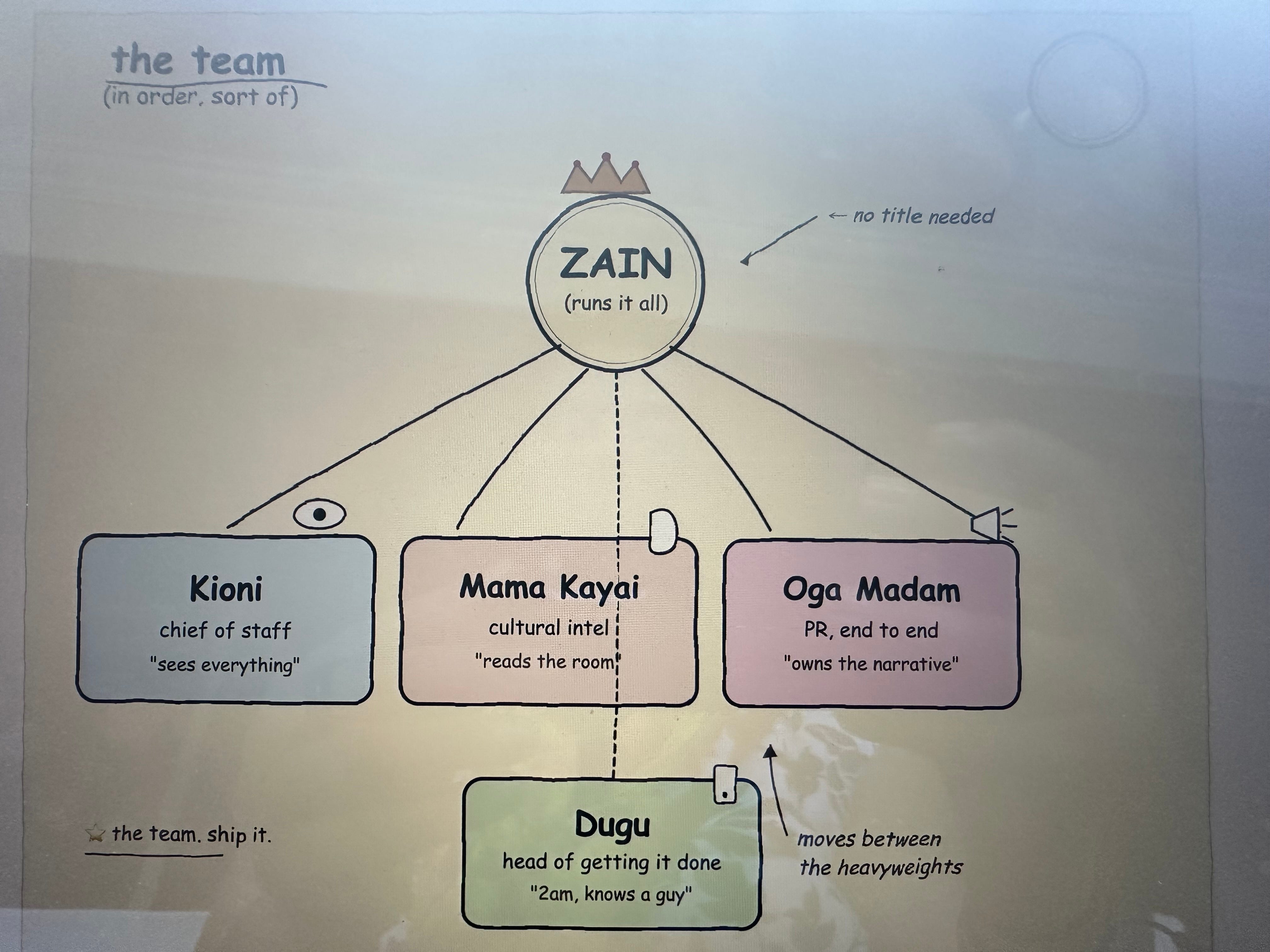
My Org Chart
Me. The human, in charge, with judgement, ethics and creativity sits at the top. 4 agents are below me. None of them human. Each hired for a different kind of intelligence. They are not tool A or tool B. They are named and have clear roles. I have more friends now, hurrah!
Of the four, one is fully built and running. One is live and refining. One is mid-build on my desktop. One is a role I have named and not yet filled. I am going to walk you through all 4 in the order they exist today, most built to least built, because for me watching my team get assembled is more useful than watching a finished one perform.
Oga Madam, PR, End-to-End. Built. Running.
Oga Madam. Bossy Lady. She executes. The entire process within a public relations or communications firm and a corporate communications team has been automated by myself into a workflow.
I’ve replaced processes I find tedious, expensive time drains, and can do better than humans at times. Oga Madam lives in Claude Code as “slash” commands chained into one product. The render at the end is a website to send a client from the entire process.
/sector-analysis → /client-brief → /lean-canvas → /media-analysis →
/north-star → /key-messages → /pr-narrative → /press-release →
/announcement → /media-pitch → /spokesperson → /voice-check → /render
Each command reads what the previous one wrote. The dependency chain is the whole product. A full client engagement: research, narrative, press release, pitch, spokesperson brief, the lot, runs end to end in an hour. This is work a retainer team used to bill for 2 weeks. Oga Madam is the most mature agent on the team. I wrote about her architecture on LinkedIn last month.
I want to make this accessible to small and medium-sized businesses who cannot pay top dollars for communications firms to do this kind of work. The human value lies in judgment: what is not a story, what is incorrect, what is ethical, the human connections and the human outreach and creativity.
The human judgment sits inside every command. The machine produces structure. The senior operator, me, or someone with experience, directs and approves the content inside the structure. The stack amplifies the operator. It does not replace them.
What dies in this model: the mechanical 80%. The research pass, the first-draft press release, the per-journalist pitch, the quote bank, the spokesperson brief. What does not die: which story to tell, to whom, at what risk. The judgment layer is now the entire billable layer.
Kioni, Chief of Staff. Live. Daily.
You know her now. I’ve written a lot about this on this Substack. She runs the day. The inbox, the standup, the pipeline, the strategic perspective. Sharp, warm, Kenyan. Has been here 5 years. Has opinions and says them. Signs off .
This is where my strategy meets execution. She is live, daily, and the agent I interact with most. Different surface from Oga Madam, Kioni runs in Claude Cowork. A different jobs, different tools, on purpose.
Mama Kayai, Cultural Intelligence. In Build.
For those that remember Vitimbi in Kenya. LOL. I could not help myself in naming her this. Mama Kayai reads the room. When a story touches Kenyan business dynamics or trust architecture, or ethnic dynamics Kioni interacts with Mama Kayai automatically and frames it with the data I have gathered that sits in another file.
Mama Kayai for now lives on my desktop right now, not in a chat window. Her knowledge base is numerous rows of Kenyan cultural intelligence, real companies, real failures, real field interviews. Not country-report abstraction. The actual texture of how business moves in Nairobi, Kisumu, Mombasa.
I had started in one place only so i have limited data. I have a set of data on what makes a foreign business succeed or fail in Kenya from a cultural standpoint. Companies I watched fail because they misread an ethnic business signal. Each row I have is a real situation with a real pattern attached. If you are building your own version for your market, that is the method, 1 row at a time, from the field. Not from reports. Not from LLM-generated summaries of reports.
She goes live when the structuring is done. I will write that post when it happens.
Dugu, Head of Getting It Done. Named. Not built.
Dugu is brother, or bro. The one in the group chat at 2am who knows a guy… Dugu is a role I have named and not yet filled. I am holding the seat because I know the work he will do, and I know Kioni, Oga Madam, and Mama Kayai are not the right agents for it. He is the one who, when a flight cancels at 11pm, finds the rebook, drafts the apology to the client, and queues both for me to approve by 7am. Logistics, unblocking, the 2am problem. I am not building him until I am sure what makes him a different agent rather than a Kioni feature.
I am telling you this because it is the honest part of building a team. You do not assemble 4 agents in a weekend. You start with the 1 who unblocks the most time, build the 2nd when the 1st cannot stretch any further, and you hold the 3rd and 4th seats open until the work tells you what they need to be.
Why a team of agents and not 1 agent
The first instinct is to load every job into a single agent. Chief of staff plus PR plus cultural read plus logistics. 1 file, 1 voice, 1 context window. It does not work. Not because the agent is not capable. Because the contexts pollute each other. Load PR voice into the same agent that runs your standup, and the standup starts sounding like a press release. Load cultural-read mode next to logistics, and the cultural read gets logistics-flavored, flattened, action-oriented, losing the subtext.
The 4-agent structure is not about scale. It is about clean voices. Each agent has 1 job, 1 set of files, 1 register. They do not interrupt each other. I invoke the right one for the work.
I am the Oga at the top still. The agents draft, flag, and surface. I decide. I send. The org chart has 1 human in it for a reason.
The Files for Subscribers
Do become a paid subsriber to this Substack where I share not jsut waht I am doing but how I am doing it. You can also directly message me for help 1-1. It’s $15 a month. Thank you!
